Saturn in the seventh house – General, positive, and negative traits
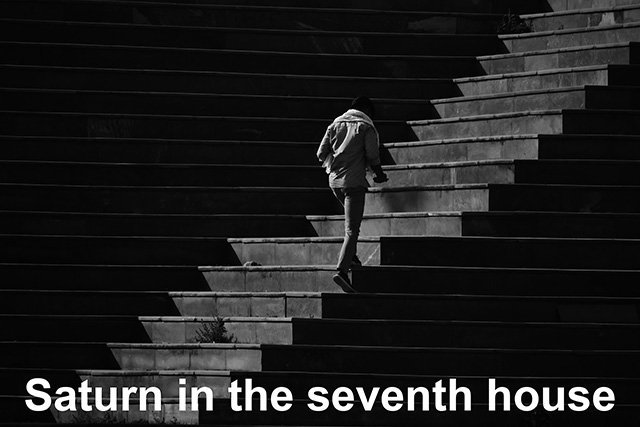
General traits of Saturn in the seventh house
-
A serious and cautious approach to relationships
Individuals with Saturn in the seventh house tend to take commitment seriously. They may be slow to form close partnerships, but once committed, they tend to stay.
-
High standards and expectations in others
There is often a quiet pressure to “get relationships right”—which may lead to hesitancy, perfectionism, or emotional distance in early bonds.
-
Fear of dependence or rejection
Relationships can be fraught with ambivalence: a longing for closeness, paired with a fear of losing self, control, or dignity.
-
Delayed or hard-earned intimacy
Romantic or personal partnerships may arrive later in life, or come after difficult early experiences that taught them about emotional boundaries.
-
A deep need for trust, loyalty, and structure
These individuals often value clarity in commitments and may avoid relationships that feel unstable, dramatic, or emotionally ambiguous.
Positive traits of Saturn in the seventh house
-
Loyal and enduring in partnership
Once trust is established, these individuals bring deep commitment, emotional responsibility, and a grounded presence to their closest bonds.
-
Skilled at building long-term partnerships
They are often excellent at defining roles, managing conflict, and maintaining integrity in relationship dynamics.
-
Clear boundaries and relational ethics
These individuals usually know where they end and others begin, making them respectful and trustworthy partners.
-
Ability to grow through relationship challenges
They are not afraid of hard work when it comes to love—and often emerge wiser, more compassionate, and more self-aware through intimacy.
-
Deep capacity for mature love
The romance may be slow to develop, but it often becomes enduring, resilient, and rooted in shared purpose.
Negative traits of Saturn in the seventh house
-
Fear of vulnerability or emotional dependence
They may hold back affection, delay commitment, or expect rejection—especially if early relationships were marked by disappointment or absence.
-
Cynicism or over-caution in love
The desire for control may block spontaneity, intimacy, or emotional expression—leading to loneliness even within committed relationships.
-
Attracting partners who mirror internal insecurity
They may unconsciously choose partners who withhold, criticize, or reinforce their self-doubt.
-
Perfectionism in relationships
High standards may keep them from opening up until they feel entirely safe or certain—which rarely arrives on its own.
-
Difficulty trusting that they are loved for who they are
They may believe love must be earned through performance, service, or strength, rather than through vulnerability or presence.
General, positive and negative traits
Saturn expresses a set of general traits when placed in a particular house - these qualities are typically visible in a person’s character and circumstances, regardless of other factors. But how easily these traits function, and whether they tend to help or complicate things, depends on the its relationships with other planets. Harmonious aspects—like sextiles, trines, or quintiles—generally support the more constructive or “positive” expressions of Saturn. Challenging aspects—such as squares and oppositions—can create inner or outer conflict, making the more difficult traits more noticeable. A conjunction is a powerful blending of two planetary energies, but its overall effect depends on whether it receives supportive, conflicting, or mixed influences from the rest of the chart.
Summary
-
Saturn in the seventh house emphasizes long-term commitment, relational maturity, and the structure of intimate bonds.
-
Core fear: being rejected, engulfed, or unworthy of lasting love.
-
Responsibility is expressed through loyalty, relational ethics, and high standards in partnership.
-
Strengths: trustworthiness, resilience, and capacity for deep, mature love.
-
Challenges: fear of vulnerability, emotional withholding, and relational self-doubt.
Saturn as external challenge
Saturn in the 7th house often points to serious, weighty, or delayed experiences in one’s closest one-to-one relationships. Partnerships may form under pressure, such as through obligation, necessity, or social expectation, rather than emotional ease. There may be a pattern of attracting partners who are older, emotionally distant, or struggling with personal or financial burdens.
Relationships can feel more like work than joy—marked by duty, imbalance, or long-term hardship. Saturn’s external face here includes complex marriages, legal difficulties in partnership, or difficulty finding someone willing or able to commit.
Where strength and perseverance are needed
When Saturn is placed in a particular house of the birth chart, it emphasizes that area of life as a site of significant challenge and potential growth. Often this part of life feels weighty, delayed, or burdened with expectation—where we may feel inadequate, ashamed, or simply unsure of ourselves. Yet the very same area can also become a foundation for strength and maturity.
Saturn's influence invites us to engage with these themes not by escaping them, but by showing up with perseverance and intention. Over time, what begins as fear can transform into confidence, and what feels like limitation can become a source of self-respect.
This placement centers on relationships, partnerships, and the balance between self and other. There may be fears of rejection, abandonment, or being “not enough” for others, leading to cautious or delayed partnerships. Conversely, one may take on too much responsibility in relationships, trying to earn love through effort.
The task is to develop healthy boundaries and to build committed relationships based on mutual respect rather than fear. Over time, Saturn in the 7th house fosters mature, enduring partnerships rooted in integrity.
Habits that help
- Schedule regular check-ins in close relationships to clarify needs and expectations.
- Practice listening without fixing or defending—develop relational presence.
- Learn to express boundaries clearly and calmly in real time.
- Keep a journal of relationship patterns—what works, what doesn’t.
- Engage with one trusted partner (friend, therapist, mentor) for accountability in emotional growth.
What Saturn in the seventh house really feels like
Saturn in the seventh house places pressure where many seek refuge: in closeness, in intimacy, in connection. For individuals with this placement, the idea of relationship is rarely casual. Even as children, they may have felt responsible for keeping peace in the home, or for managing emotional distance between adults. Love was often associated with effort.
As adults, they may crave intimacy but fear what it will require. There can be a quiet belief that relationships must be earned—that unless they bring usefulness, control, or perfection, they won’t be loved fully. This belief creates tension: they want partnership, but struggle to trust it.
Romantic relationships often unfold slowly. These individuals may delay commitment, avoid vulnerability, or unconsciously choose partners who reinforce their guardedness. Yet beneath the caution is a longing for depth—for a relationship built on loyalty, respect, and shared values.
For those with a well-placed or supported Saturn, this placement can reflect early emotional maturity. They may understand boundaries naturally, or take relationships seriously without fear. In either case, the path involves learning to let go of control and accept that being fully loved means being fully seen—imperfections included.
Over time, they become skilled at building lasting bonds. They don’t seek fairy tales; they build something better: relationships grounded in mutual effort, honesty, and deep emotional integrity.
The long path to self-respect
Saturn in the seventh house often reveals the ways we internalize our early relationship templates. Many with this placement learned that love was conditional—or that to be in relationship meant to lose themselves. They may have become guarded, skeptical, or over-responsible in partnerships.
Therapeutically, this pattern often appears as relational perfectionism, emotional avoidance, or difficulty expressing needs. These individuals may find themselves doing more than their share, or expecting rejection before it happens.
The work, then, is not just to find the “right” partner—but to dismantle the beliefs that keep them from showing up authentically. Over time, Saturn here matures into relational wisdom: the knowledge that commitment is not about control, but about care; not about performing strength, but about building trust.
With maturity, they become capable of extraordinary love—rooted in reality, not fantasy. They learn to let others in, not because they no longer fear rejection, but because they’ve earned their own respect first.
Practical reflections and inner questions
- What do I believe I must do in order to be loved or chosen?
- Where do I feel the most guarded or cautious in relationships—and why?
- How do I define a “successful” partnership?
- What relational patterns repeat in my life—and what role do I play in them?
- How do I balance independence with vulnerability in love?
- What would it mean to trust that I am enough—just as I am?
About sign placement and aspects
The sign Saturn occupies in the seventh house colors its expression. Saturn in Libra may highlight diplomacy and fairness, while Saturn in Scorpio can bring intensity and emotional control. Benefic aspects from the Moon or Venus may soften self-protection, while hard aspects from Mars, Uranus, or Neptune may introduce conflict, instability, or deep fear of loss.
Other articles in this series:
Saturn in the first house, Saturn in the second house, Saturn in the third house, Saturn in the fourth house, Saturn in the fifth house, Saturn in the sixth house, Saturn in the seventh house, Saturn in the eighth house, Saturn in the ninth house, Saturn in the tenth house, Saturn in the eleventh house, Saturn in the twelfth house
You might also be interested in:
Saturn in Aries, Saturn in Taurus, Saturn in Gemini, Saturn in Cancer, Saturn in Leo, Saturn in Virgo, Saturn in Libra, Saturn in Scorpio, Saturn in Sagittarius, Saturn in Capricorn, Saturn in Aquarius, Saturn in Pisces
You might also be interested in:
Core principles of Saturn, The Saturn return, Interpretation of Saturn in the birth chart, Saturn in the houses: where life asks us to grow up, Introduction to Saturn in the signs
You might also be interested in: The meaning of the seventh house
You might also be interested in: The complete overview of all the characteristics of Saturn
To read more about the planets in all the signs and in all the houses - click here