Moon in Sagittarius – General, positive, and negative traits

General traits of the Moon in Sagittarius
This section outlines the emotionally expansive, freedom-loving, and idealistic qualities of the Moon in Sagittarius. Emotional life is infused with a need for meaning, movement, and a broad perspective.
-
Emotionally optimistic and forward-looking
They often approach feelings with a sense of hope, possibility, or philosophical reflection. -
Needs emotional freedom and space
They are uncomfortable with emotional environments that feel confining or overly dependent. -
Feels emotions through experiences and ideas
Travel, learning, or storytelling often serve as emotional outlets or sources of nourishment. -
Tends to generalize emotional experiences
They may look for overarching meaning rather than focusing on subtle emotional detail. -
Drawn to emotional growth and discovery
They thrive when emotional life is connected to personal exploration and learning.
Positive traits of the Moon in Sagittarius
This section highlights the emotional openness, enthusiasm, and broad-mindedness of the Moon in Sagittarius—traits that encourage growth, resilience, and a sense of adventure.
-
Emotionally adventurous and open-hearted
They welcome new emotional experiences with curiosity and optimism. -
Brings humor and perspective to emotional life
They can defuse emotional tension by helping others see the bigger picture. -
Uplifting and emotionally energizing
Their emotional style tends to elevate the mood of those around them. -
Values truth and emotional honesty
They are often straightforward in expressing how they feel, without pretense or manipulation. -
Emotionally resilient through belief and meaning
They cope with emotional challenges by connecting them to a sense of purpose or worldview.
Negative traits of the Moon in Sagittarius
This section addresses the emotional avoidance, restlessness, and insensitivity that can emerge with the Moon in Sagittarius, particularly when depth or commitment is required.
-
Can avoid emotional depth or complexity
They may gloss over difficult feelings in favor of staying upbeat or moving on quickly. -
Emotionally restless or easily bored
Routine emotional environments can feel stifling, leading them to seek constant novelty. -
Tends to moralize emotional issues
They may impose beliefs or philosophical judgments instead of listening with empathy. -
Struggles with emotional commitment
Long-term emotional obligations can feel limiting or burdensome. -
May overlook others’ emotional subtleties
Their big-picture focus can lead them to miss or dismiss the emotional nuance of others.
General, positive and negative traits
The Moon expresses a set of general traits when placed in a particular sign—these qualities are typically visible in a person’s character, regardless of other factors. But how easily these traits function, and whether they tend to help or complicate things, depends on the Moon’s relationships with other planets. Harmonious aspects—like sextiles, trines, or quintiles—generally support the more constructive or “positive” expressions of the Moon. Challenging aspects—such as squares and oppositions—can create inner or outer conflict, making the more difficult traits more noticeable. A conjunction is a powerful blending of two planetary energies, but its overall effect depends on whether it receives supportive, conflicting, or mixed influences from the rest of the chart.
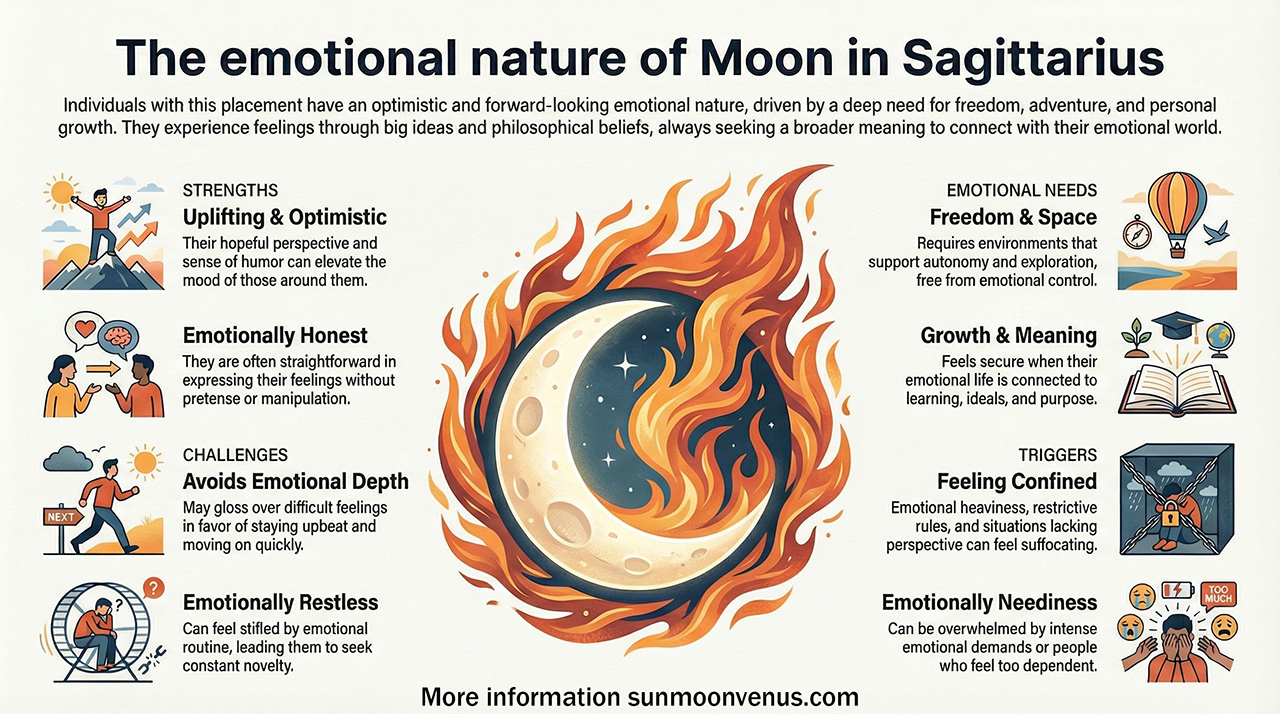
The Moon in Sagittarius: Emotions, security and feeling connected
When the Moon is in Sagittarius, the emotional life is imbued with a quest for meaning, freedom, and experience. These individuals often feel most emotionally alive when they are learning, traveling, or pushing beyond the boundaries of the familiar. Their emotional world is shaped not only by personal history but by ideals, philosophies, and aspirations that stretch beyond the self. They may use belief systems—religious, moral, or intellectual—to interpret and navigate emotional life, finding solace in the broader narrative rather than the immediate feeling.
While this offers perspective and resilience, it can also lead to emotional bypassing if discomfort is reframed too quickly. Their instinct is to move rather than sit—to solve emotional unrest by changing scenery, pursuing a new idea, or finding humour in hardship. They are often emotionally generous, tolerant, and accepting of difference, but may struggle with closeness if it feels like emotional confinement. Their need for freedom is emotional as much as physical—they resist being boxed in by expectations, guilt, or unresolved heaviness.
In relationships, they seek companions for the journey—partners who stimulate the mind, share ideals, and embrace growth. Early emotional conditioning may have emphasized moral behaviour, independence, or a need to “rise above” emotion, shaping an adult who seeks inspiration more than intimacy. At their best, Moon in Sagittarius individuals bring emotional honesty, enthusiasm, and vision. At their most challenged, they may become escapist, dogmatic, or emotionally inconsistent. House placement and aspects to the Moon offer further insight into how these qualities unfold.
Emotional needs when the Moon is in Sagittarius
To feel emotionally secure, individuals with the Moon in Sagittarius need space—both literal and psychological. They require environments that support exploration, autonomy, and the pursuit of meaning, rather than emotional control or containment. Intellectual stimulation is vital: they need to feel they are learning, growing, and expanding, even in emotional life. They are nourished by laughter, adventure, and shared ideals; emotional heaviness must be balanced with lightness and movement.
They thrive in relationships that offer emotional openness and freedom, rather than enmeshment or emotional intensity. Honest communication, including the ability to express doubts or changing beliefs, helps them feel emotionally authentic. Above all, they need to feel that their emotional life is part of a larger journey—something with purpose, growth, and direction.
Emotional challenges and unhappiness for the Moon in Sagittarius
Moon in Sagittarius individuals become emotionally uneasy in environments that feel confining, emotionally stagnant, or overly serious. They are often uncomfortable with emotional heaviness that lacks perspective or humour, and may distance themselves from people or situations that feel too emotionally demanding. Their tendency to seek escape—whether through distraction, travel, or belief—can become avoidance when they fear emotional vulnerability. They may also become impatient with their own or others’ emotional complexity, preferring clarity and simplicity even when life does not offer it.
In relationships, they can feel suffocated by neediness or rules, leading them to withdraw or rebel. If their optimism is repeatedly disappointed, they may become cynical or emotionally detached, masking vulnerability with sarcasm or detachment. Their emotional growth lies in learning to stay present through discomfort, to balance freedom with responsibility, and to trust that emotional truth need not threaten their independence—it can, in fact, deepen it.
The difference between men and women when the Moon is in Sagittarius
The Moon in your birth chart speaks to your emotional patterns, your instinctive responses, and the atmosphere of early caregiving—especially your relationship with your mother. For women, the Moon often feels deeply personal, resonating with their core sense of self and their habitual ways of feeling, nurturing, and needing. In fact, many women may identify more readily with their Moon sign than with their Sun, particularly when it comes to their inner life and emotional landscape.
For men, the Moon still speaks to emotional needs, but it also often symbolizes the kind of feminine energy they unconsciously seek or encounter in the world—though not necessarily in romantic relationships, which are more closely tied to Venus. Across all genders, the Moon reveals the tone of early emotional imprinting and continues to shape how one responds to comfort, vulnerability, and care throughout life.
Signs, houses, aspects and emotional development
To fully understand the meaning of the Moon in a birth chart, one must look beyond its house position and consider its sign, which reveals how emotions seeks expression. Equally important are the aspects it makes to other planets, shaping how the feeling self integrates—or struggles to integrate—with other dimensions of the psyche.
Transits and secondary progressions show how the Moon’s expression evolves over time, reflecting key phases in emotional development and shifts in feeling-tone, needs and the ability to be at ease - or the struggle to trust and episodes of emotional turmoil. An experienced astrologer weaves together this multi-layered complexity and translates it into clear, meaningful language that supports deeper insight and growth.
Other articles in this series:
The Moon in Aries, The Moon in Taurus, The Moon in Gemini, The Moon in Cancer, The Moon in Leo, The Moon in Virgo, The Moon in Libra, The Moon in Scorpio, The Moon in Sagittarius, The Moon in Capricorn, The Moon in Aquarius, The Moon in Pisces
You might also be interested in:
The Moon in the first house, The Moon in the second house, The Moon in the third house, The Moon in the fourth house, The Moon in the fifth house, The Moon in the sixth house, The Moon in the seventh house, The Moon in the eighth house, The Moon in the ninth house, The Moon in the tenth house, The Moon in the eleventh house, The Moon in the twelfth house
You might also be interested in: The meaning of the Moon in the birth chart
You might also be interested in: The Moon, the fourth house and emotional safety,
You might also be interested in: The complete overview of all the characteristics of the Moon
To read more about the planets in all the signs and in all the houses, click here.