Moon in Aquarius – General, positive, and negative traits

General traits of the Moon in Aquarius
This section explores the emotionally detached, intellectually oriented, and socially aware qualities of the Moon in Aquarius. Emotional life is often filtered through a need for perspective, autonomy, and idealism.
-
Emotionally independent and internally driven
They prefer to manage their own feelings without relying heavily on others. -
Needs emotional space and objectivity
Closeness is welcome, but only when it allows for autonomy and reflection. -
Processes emotions through ideas and concepts
They often understand their feelings by framing them within systems or ideologies. -
Feels emotions in a socially contextual way
Their emotional identity is linked to group values, collective ideals, or humanitarian concerns. -
Drawn to emotional innovation and the unconventional
They are open to alternative emotional expressions and nontraditional relationship dynamics.
Positive traits of the Moon in Aquarius
This section highlights the Moon in Aquarius's emotional intelligence, forward-thinking qualities, and ability to connect with others through shared vision and insight.
-
Emotionally objective and fair-minded
They are often able to step back and view emotional situations with clarity and neutrality. -
Cares deeply about collective well-being
Their empathy often extends to groups, causes, or the broader human condition. -
Emotionally steady and calm under pressure
They can maintain composure in emotionally volatile situations, offering a stabilizing presence. -
Innovative in emotional relationships
They bring creativity and openness to the way emotions are expressed and shared. -
Encourages emotional authenticity in others
They support others in being true to themselves, especially when it defies social norms.
Negative traits of the Moon in Aquarius
This section addresses the potential for emotional detachment, inconsistency, and interpersonal aloofness in those with the Moon in Aquarius, particularly when their need for distance becomes avoidance.
-
Can seem emotionally detached or unavailable
They may struggle to engage with others on a deeply personal or intimate level. -
Tends to intellectualize or avoid raw emotion
They may retreat into abstract thinking to sidestep emotional discomfort. -
May undervalue emotional closeness
Personal intimacy can feel confining, prompting withdrawal or resistance. -
Emotionally inconsistent or unpredictable
They may surprise others with sudden shifts or emotional aloofness. -
Can become overly idealistic about emotions
They may hold emotional expectations that are too utopian or detached from personal reality.
General, positive and negative traits
The Moon expresses a set of general traits when placed in a particular sign—these qualities are typically visible in a person’s character, regardless of other factors. But how easily these traits function, and whether they tend to help or complicate things, depends on the Moon’s relationships with other planets. Harmonious aspects—like sextiles, trines, or quintiles—generally support the more constructive or “positive” expressions of the Moon. Challenging aspects—such as squares and oppositions—can create inner or outer conflict, making the more difficult traits more noticeable. A conjunction is a powerful blending of two planetary energies, but its overall effect depends on whether it receives supportive, conflicting, or mixed influences from the rest of the chart.
The Moon in Aquarius: Emotions, security and feeling connected
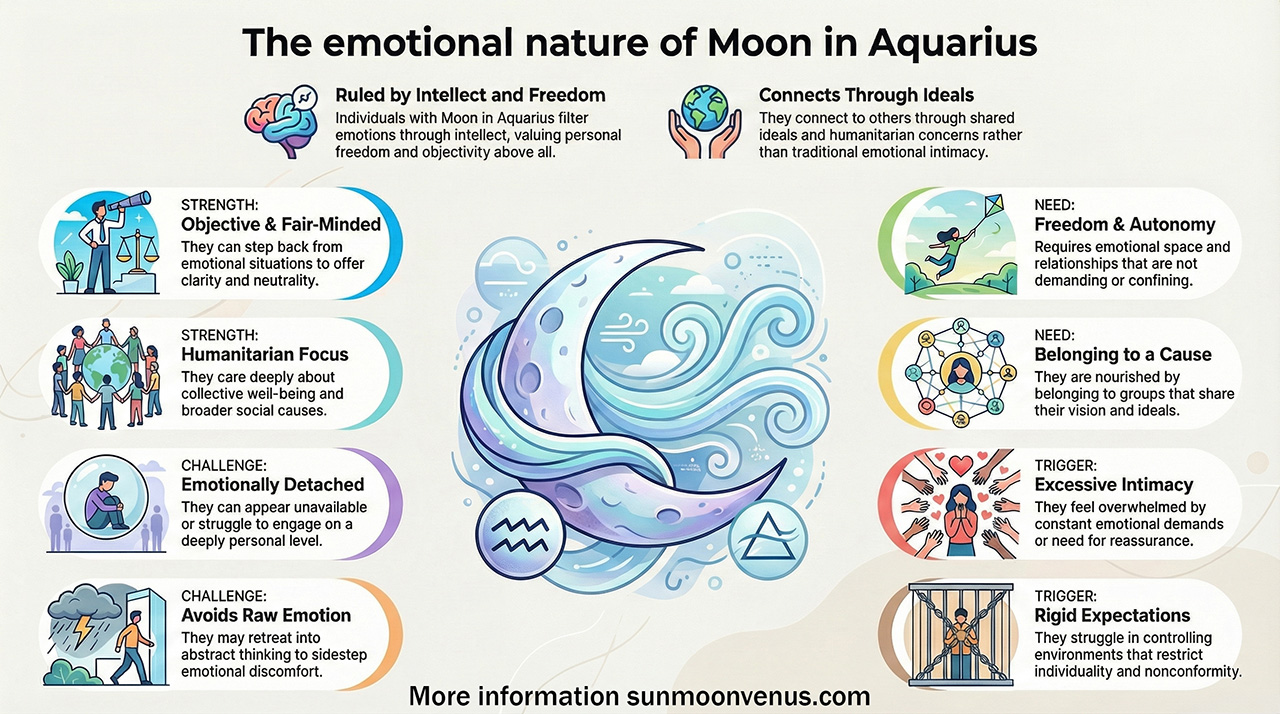
When the Moon is in Aquarius, the emotional world is shaped by thought, idealism, and a strong need for personal autonomy. These individuals often feel most secure when they have space—not just physically, but psychologically—to explore their own ideas and emotional rhythms. Their emotional responses tend to be filtered through analysis or reflection, rather than raw feeling, giving them a cool, composed exterior even in emotionally charged situations. This detachment doesn’t mean they don’t care; rather, they prefer to show care through thoughtful acts, shared ideals, or support of another’s individuality rather than through emotional intimacy. Emotional predictability can make them uneasy—they are drawn to novelty, change, and the unusual, and this extends to their inner life.
Relationships are important to them, but they seek connections that are intellectually stimulating and emotionally non-invasive. Early life may have emphasized difference, individuality, or emotional unpredictability, creating an adult who resists being emotionally defined by others. They are often emotionally invested in social causes, communities, or friendships more than in traditional family structures.
While they can bring clarity, innovation, and emotional spaciousness to relationships, they may also struggle with intimacy, preferring emotional independence even when deeper closeness is possible. At their best, Moon in Aquarius individuals are emotionally intelligent, idealistic, and nonjudgmental. At their most challenged, they may become emotionally withdrawn, inconsistent, or resistant to genuine emotional connection. House placement and aspects to the Moon provide further detail in understanding how this Moon functions in a chart.
Emotional needs when the Moon is in Aquarius
To feel emotionally secure, individuals with the Moon in Aquarius need freedom, intellectual stimulation, and a sense of belonging to something larger than themselves. They are nourished by ideas, vision, and emotional environments that support innovation and nonconformity. Emotional connection must feel authentic and allow room for individuality—relationships that are emotionally demanding or overly traditional often feel stifling.
They thrive in friendships, networks, and collaborative environments where they can share values, interests, and ideals. Predictability is less important to them than openness—they prefer emotional flexibility and the opportunity to question norms. They also need time alone to recalibrate emotionally, especially after intense interpersonal exchanges. Above all, they need to feel emotionally accepted not for how well they conform, but for their uniqueness and their capacity to challenge the status quo with integrity.
Emotional challenges and unhappiness for the Moon in Aquarius
Moon in Aquarius individuals can become emotionally distressed in environments that are emotionally rigid, controlling, or excessively intimate. They struggle with emotional intensity that demands constant attention, and may feel overwhelmed by people who require ongoing emotional reassurance. Their preference for objectivity can lead them to suppress or overlook their own feelings, which can build up as disconnection or emotional flatness.
In relationships, their tendency to withdraw or intellectualize can leave partners feeling unseen or emotionally dismissed. They may also feel alienated in conventional emotional roles or settings that don't reflect their values. Emotional boredom can lead to rebellious behavior or detachment, particularly if they feel trapped in social or family expectations. Their emotional growth involves learning to tolerate emotional ambiguity, to trust the vulnerability of connection, and to balance their need for space with their need to belong.
The difference between men and women when the Moon is in Aquarius
The Moon in your birth chart speaks to your emotional patterns, your instinctive responses, and the atmosphere of early caregiving—especially your relationship with your mother. For women, the Moon often feels deeply personal, resonating with their core sense of self and their habitual ways of feeling, nurturing, and needing. In fact, many women may identify more readily with their Moon sign than with their Sun, particularly when it comes to their inner life and emotional landscape.
For men, the Moon still speaks to emotional needs, but it also often symbolizes the kind of feminine energy they unconsciously seek or encounter in the world—though not necessarily in romantic relationships, which are more closely tied to Venus. Across all genders, the Moon reveals the tone of early emotional imprinting and continues to shape how one responds to comfort, vulnerability, and care throughout life.
Signs, houses, aspects and emotional development
To fully understand the meaning of the Moon in a birth chart, one must look beyond its house position and consider its sign, which reveals how emotions seeks expression. Equally important are the aspects it makes to other planets, shaping how the feeling self integrates—or struggles to integrate—with other dimensions of the psyche.
Transits and secondary progressions show how the Moon’s expression evolves over time, reflecting key phases in emotional development and shifts in feeling-tone, needs and the ability to be at ease - or the struggle to trust and episodes of emotional turmoil. An experienced astrologer weaves together this multi-layered complexity and translates it into clear, meaningful language that supports deeper insight and growth.
Other articles in this series:
The Moon in Aries, The Moon in Taurus, The Moon in Gemini, The Moon in Cancer, The Moon in Leo, The Moon in Virgo, The Moon in Libra, The Moon in Scorpio, The Moon in Sagittarius, The Moon in Capricorn, The Moon in Aquarius, The Moon in Pisces
You might also be interested in:
The Moon in the first house, The Moon in the second house, The Moon in the third house, The Moon in the fourth house, The Moon in the fifth house, The Moon in the sixth house, The Moon in the seventh house, The Moon in the eighth house, The Moon in the ninth house, The Moon in the tenth house, The Moon in the eleventh house, The Moon in the twelfth house
You might also be interested in: The meaning of the Moon in the birth chart
You might also be interested in: The Moon, the fourth house and emotional safety,
You might also be interested in: The complete overview of all the characteristics of the Moon
To read more about the planets in all the signs and in all the houses, click here.